
Hot Chamber Die Casting Process in Modern OEM Manufacturing


Blogpost keywords: hot chamber die casting process, precision casting workflow, OEM die casting manufacturing
The hot chamber die casting process remains one of the most efficient manufacturing methods for producing high-volume metal components with consistent dimensional stability and fast production cycles.
Why the Hot Chamber Die Casting Process Supports Fast Production Efficiency
In the hot chamber die casting process, the injection mechanism is directly submerged inside the molten metal reservoir. This structure is commonly known as the piston or gooseneck system. Unlike cold chamber systems where molten metal must be ladled into the shot sleeve for every cycle, the integrated structure of the hot chamber system allows metal to flow directly into the cylinder when the plunger retracts. Once the plunger advances, molten metal is rapidly forced into the die cavity under pressure.
From an OEM production perspective, this design significantly improves cycle speed and process continuity. At SHD Precision Die Casting, we often see this method preferred for zinc-based alloy production where fast repetition and dimensional consistency are critical.
The precision casting workflow in this system is highly dependent on timing and thermal control. Since the injection unit remains in constant contact with molten metal, temperature stability becomes one of the key advantages of the process.
How Core Structures Influence Casting Formation
One of the most important stages in OEM die casting manufacturing involves the positioning of the die core.
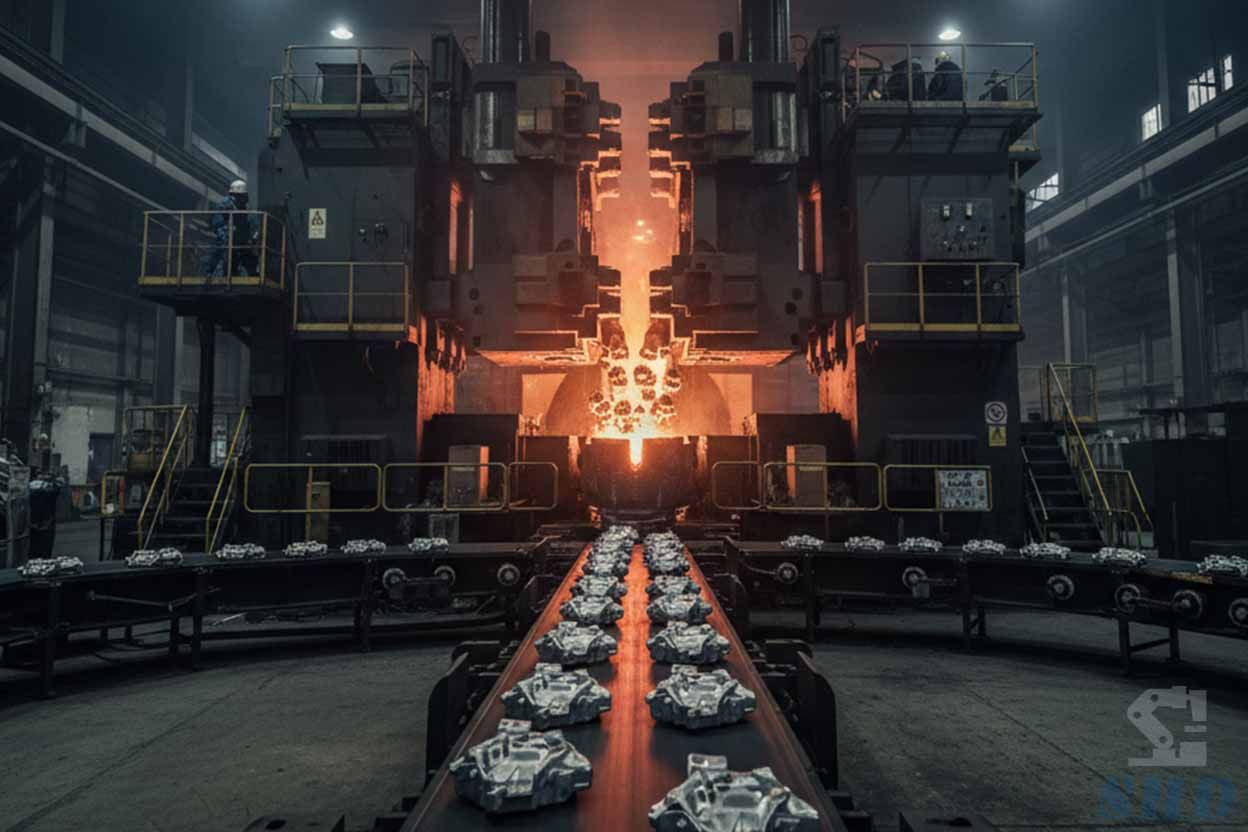
Before molten metal enters the cavity, the core structure is already locked into place inside the die. As the metal fills the cavity, it surrounds the core and forms the internal geometry of the component. Once the metal solidifies, the die core retracts before the die opens. This sequence may appear mechanically simple, but it directly affects casting accuracy, internal structure quality, and surface consistency.
In complex precision casting workflow applications, improper core alignment can lead to flash defects, dimensional variation, or incomplete cavity formation. This is especially important when manufacturing thin-wall components or parts with internal channels. At SHD Precision Die Casting, core movement synchronization is one of the critical engineering points we monitor during tooling development.
Common Misunderstandings About Hot Chamber Systems
A frequent misconception is that the hot chamber die casting process is universally suitable for all alloy types. In reality, the process is mainly used for lower-melting-point alloys such as zinc and magnesium. Aluminum alloys are generally unsuitable because their higher melting temperatures can damage submerged injection components over time.
Another misunderstanding is assuming that faster cycle speed automatically means lower manufacturing complexity. While the process itself is highly efficient, mold cooling balance, injection pressure control, and die lubrication still require careful optimization. OEM die casting manufacturing is rarely just about speed. Stable repeatability is equally important.
Practical Considerations in Precision Casting Workflow
For OEM buyers, understanding the production sequence can help during early product development. Features such as undercuts, internal cavities, and thin-wall structures directly influence whether retractable core systems are required. In many cases, minor design adjustments can simplify tooling complexity and improve long-term production stability.
The precision casting workflow also benefits from considering post-processing requirements early. Surface treatment compatibility, machining allowance, and assembly tolerances should all be evaluated before tooling begins.
Conclusion
The hot chamber die casting process combines high-speed production with stable dimensional control, making it highly effective for zinc alloy OEM manufacturing when supported by a properly engineered precision casting workflow.
Supporting Efficient OEM Production
At SHD Precision Die Casting, our OEM die casting manufacturing approach focuses on tooling coordination, thermal stability, and repeatable production control. From core structure design to final casting ejection, we support precision casting workflow solutions tailored to long-term industrial production needs.