
The Zinc Alloy Casting Market Is Moving Toward Higher-Value Components


The Zinc alloy casting market has developed from a reliable source of decorative hardware into a broader manufacturing field for precise, functional, and highly finished metal components. At SHD Precision Die Casting, we see this development as a change in how customers evaluate zinc: not only by material price, but also by detail reproduction, tool life, production speed, and the ability to reduce secondary assembly.
How the Zinc Alloy Casting Market Began to Expand
Early zinc die casting was strongly associated with locks, handles, ornaments, small fittings, and other products that benefited from good surface quality. Zinc alloys could fill detailed cavities and accept plating or painting with relatively little preparation, making them useful for visible consumer parts.
This foundation still matters, but zinc die casting applications have expanded. Modern projects may include automotive interior hardware, electronic connectors, precision mechanisms, appliance components, control parts, and compact structural housings. The market moved forward because designers began using zinc for both appearance and mechanical function.
From Decorative Parts to Precision Engineering
The next stage in the Zinc alloy casting market was driven by tighter dimensional requirements and greater part integration. Instead of casting a simple shell and attaching several separate pieces, manufacturers could form bosses, ribs, threads, bearing surfaces, and fastening details in one component.
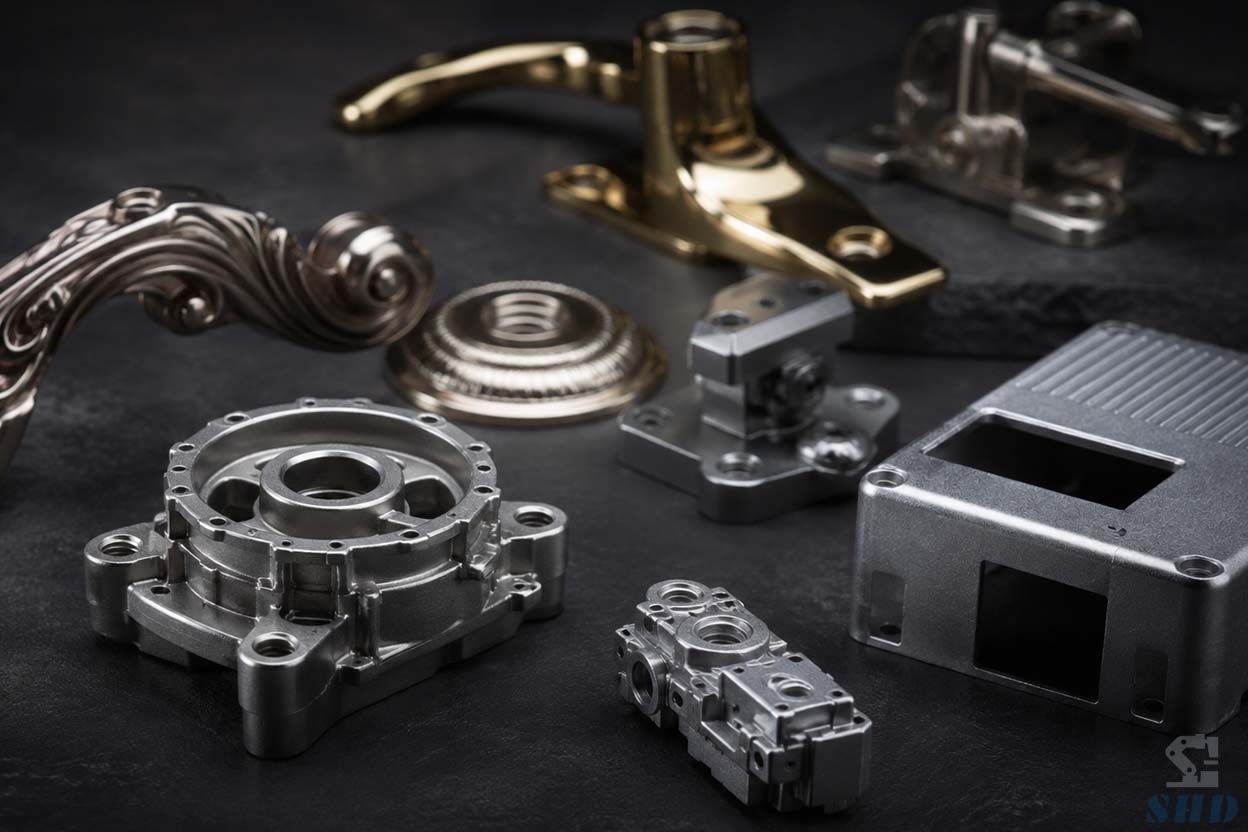
For precision zinc components, this integration can reduce machining and assembly. Zinc's fluidity also supports thin sections and fine features that may be difficult to reproduce consistently with some other casting alloys.
At SHD Precision Die Casting, we often assess whether separate fastening, structural, and decorative features can be incorporated into one cast design before tooling begins. This approach can simplify the final assembly while giving precision zinc components a substantial feel and greater flexibility for plating, coating, or polishing.
Alloy Development Created New Design Paths
The Zinc alloy casting market has also benefited from a wider understanding of alloy selection. Conventional ZAMAK alloys remain widely used, while ZA alloys and high-fluidity formulations give engineers additional choices for strength, wear behavior, thin-wall filling, and finishing.
This does not mean one alloy is suitable for every project. Precision zinc components must be matched to working temperature, loading, corrosion exposure, dimensional expectations, and surface treatment. Casting conditions also affect final properties, so stable metal temperature, die temperature, injection control, and cooling remain important during production.
Where Future Growth Is Likely to Come From
Future zinc die casting applications are likely to focus on smaller integrated parts rather than very large lightweight structures. Electronics, smart hardware, mobility systems, furniture fittings, medical equipment housings, and precision industrial mechanisms can all benefit from zinc's combination of detail, strength, and finish quality.
Sustainability will also influence purchasing decisions. Long die life, fast production cycles, recyclable metal, reduced machining, and part consolidation can improve material and process efficiency. However, these advantages depend on thoughtful component design and consistent process control.
From our production perspective, buyers are also becoming more interested in complete project support. They expect suppliers to coordinate tooling, casting, trimming, CNC machining, polishing, plating, coating, inspection, and assembly rather than delivering only raw castings.
Conclusion
The Zinc alloy casting market has progressed by moving from decorative mass production toward engineered, integrated, and finish-ready components. Its next stage will depend on better alloy selection, more stable process control, and zinc die casting applications that use the material's full design potential.
Developing Zinc Components for Modern OEM Projects
At SHD Precision Die Casting, we support the Zinc alloy casting market through manufacturability review, tooling development, casting control, machining, finishing, and inspection. Our goal is to help customers develop precision zinc components that are practical to manufacture and consistent across long-term production.