
SHD Precision Diecasting Capabilities for OEM Metal Components


SHD Precision Diecasting provides integrated die casting capabilities for customers who need reliable metal components from design review to production delivery. As OEM projects become more demanding, die casting is no longer only about forming metal quickly. It must also support material performance, dimensional stability, tooling quality, secondary machining, surface finishing, and final inspection.
For this reason, SHD Precision Diecasting builds its service around a complete manufacturing route instead of treating casting as a single isolated process.
Die Casting Capabilities Built Around Aluminum, Magnesium, and Zinc Alloys
Material selection is one of the first decisions in any die casting project. Different alloys create different advantages in strength, weight, fluidity, surface quality, machining behavior, and cost control.
Aluminum die casting is widely used for structural housings, brackets, motor components, industrial equipment parts, and lightweight OEM components. It offers a practical balance between strength, corrosion resistance, thermal performance, and production efficiency.
Magnesium die casting is often considered when aggressive weight reduction is required. Its low density makes it suitable for applications where lightweight performance affects the final product, such as automotive structures, electronics, and precision equipment.
Zinc die casting is valuable for small, detailed, and dimensionally stable parts. Zinc alloys provide excellent fluidity, allowing fine features, thin walls, and decorative surfaces to be formed with strong repeatability.
By supporting aluminum, magnesium, and zinc alloy projects, SHD Precision Diecasting can help customers compare different material routes before tooling begins.
From Mold Development to Stable Casting Production
A successful die casting part begins with tooling. Mold design affects metal flow, filling stability, cooling balance, parting lines, ejector layout, shrinkage control, and long-term production consistency. At SHD Precision Diecasting, tooling is reviewed together with product geometry and expected production requirements.
For OEM die casting parts, details such as wall thickness, ribs, bosses, undercuts, draft angles, and machining allowance must be evaluated before mold fabrication. A small design change at this stage may reduce casting defects, simplify production, and improve final quality.
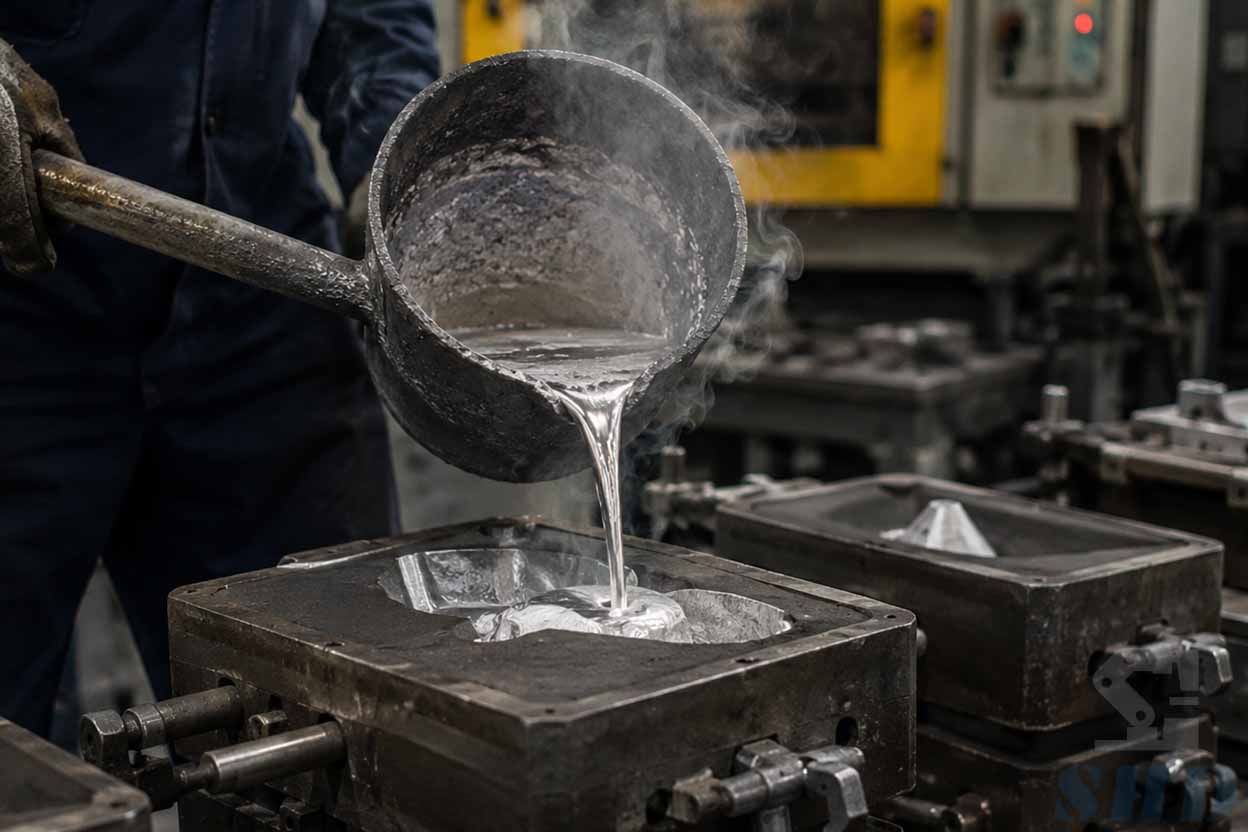
The company also supports high-pressure die casting production, which is suitable for producing precision parts from aluminum, zinc, and magnesium alloys. This process is commonly used for automotive components, electronic housings, appliance parts, and industrial equipment components.
Semi-Solid Die Casting for Higher Performance Requirements
In addition to conventional die casting, SHD Precision Diecasting also presents semi-solid die casting capability. This process is especially useful for lightweight metals such as aluminum and magnesium alloys. Compared with traditional die casting, semi-solid forming can support improved mechanical properties, better dimensional accuracy, and more stable performance in selected applications. It is often considered when customers need stronger lightweight components or parts with higher durability requirements.
This capability gives OEM customers another manufacturing option when standard die casting may not fully meet performance expectations.
CNC Machining and Surface Finishing After Casting
Many die-cast components require secondary operations after the raw casting is produced. CNC machining may be needed for holes, threads, sealing surfaces, bearing positions, mounting faces, or critical tolerance areas. This is especially important when a casting must fit into a mechanical assembly or meet precise functional requirements.
Surface treatment is also an important part of die casting capabilities. Die-cast parts may need polishing, sandblasting, coating, spraying, plating, or other finishing processes to improve appearance, corrosion resistance, wear resistance, or long-term durability.
By combining casting, machining, and finishing, SHD Precision Diecasting can support OEM die casting parts from raw casting to finished component.
Inspection and Project Support for OEM Customers
Quality control is essential in die casting because defects may appear in different forms. Some issues are visible on the surface, while others may only become clear after machining, finishing, or assembly testing.
For this reason, inspection should not be limited to final appearance. It should also consider dimensional accuracy, machining surfaces, functional zones, and production consistency.
SHD Precision Diecasting supports project communication from early design review to sampling and batch production. This is valuable for customers developing new products, improving existing components, or transferring parts into more scalable manufacturing.
Conclusion
SHD Precision Diecasting offers die casting capabilities that cover alloy selection, tooling development, high-pressure die casting, semi-solid die casting, CNC machining, surface finishing, and inspection. For OEM customers, this integrated approach helps turn product designs into stable, production-ready metal components.
Supporting OEM Die Casting Projects With Practical Manufacturing Experience
SHD Precision Diecasting works with customers who need aluminum, magnesium, and zinc alloy components for automotive, electronics, energy storage, medical equipment, industrial motors, and other demanding applications. Through coordinated tooling, casting, machining, finishing, and inspection support, the company helps customers develop OEM die casting parts with reliable quality and scalable production potential.