
Metal Die Casting Challenges Affect Quality From Tooling to Finishing


Metal die casting challenges arise because molten alloy, steel tooling, pressure, temperature, and cooling must work together within a very short production cycle. At SHD Precision Die Casting, we find that stable results rarely depend on one machine parameter alone. Part design, mold condition, alloy behavior, and operator control all influence the final casting.
Why Metal Die Casting Challenges Require Complete Process Coordination
High-pressure die casting can produce complex metal components quickly, but the speed of the process leaves limited room for error. Molten metal must enter the cavity, push out air, fill thin sections, and begin solidifying almost immediately. If injection speed is too low, cold shuts or incomplete filling may appear. If it is too high, turbulent flow may trap gas and increase porosity. Effective die casting process control therefore requires balanced settings rather than maximum pressure or speed.
The correct production window also changes according to aluminum, zinc, or magnesium alloy behavior. Each material responds differently to temperature, flow distance, wall thickness, and cooling conditions.
Porosity Can Remain Hidden Until Machining
Porosity is one of the most difficult metal die casting challenges because it is not always visible on the raw casting surface. Gas pockets or shrinkage cavities may only appear after CNC machining removes the outer material layer. These internal defects can affect sealing surfaces, threaded holes, structural zones, and decorative finishes. Die casting defect prevention begins with gate design, overflow positioning, venting, vacuum control, and stable injection parameters.
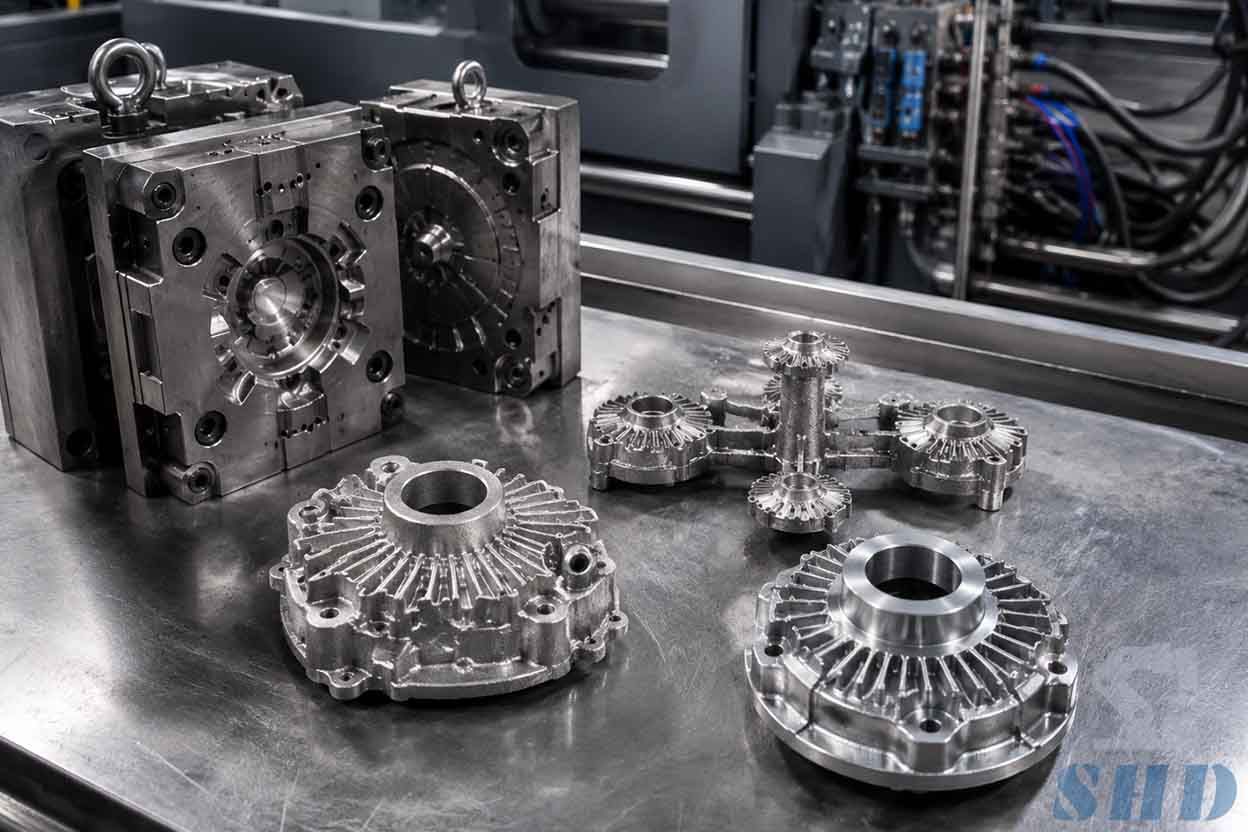
At SHD Precision Die Casting, we pay particular attention to parts with deep cavities, thick-to-thin wall transitions, or large machined areas because these designs often carry a greater internal quality risk.
Thermal Balance Changes During Continuous Production
A die does not remain at one constant temperature throughout the working day. It warms during repeated cycles and cools during interruptions, maintenance, or spraying adjustments.
An unstable thermal condition may cause dimensional movement, local shrinkage, sticking, flash, or surface marks. Cooling channels, spray time, cycle speed, and die temperature must therefore be considered together. Practical die casting process control includes observing how the part changes after the mold reaches its normal working temperature. Approving only the first few samples may not represent long-term production stability.
Tool Wear Gradually Influences Casting Quality
Another challenge is that tooling condition changes over time. Parting lines may wear, vents may become blocked, sliding cores may lose smooth movement, and ejector pins may begin marking or deforming the casting.
Heat checking can also develop on mold surfaces after repeated heating and cooling. Small cracks may first appear as minor surface lines but gradually become more visible.
Regular cleaning, lubrication, dimensional inspection, and preventive mold maintenance are essential parts of die casting defect prevention.
Complex Designs Increase Manufacturing Risk
Thin walls, deep ribs, sharp corners, and major thickness changes can make metal flow and solidification more difficult. Although die casting allows a high level of design integration, not every complex shape is automatically suitable for stable production.
Early manufacturability review helps identify where draft angles, fillets, ribs, gates, or machining allowances should be adjusted. This is one of the most effective ways to address metal die casting challenges before tooling investment begins.
Conclusion
Metal die casting challenges include porosity, thermal variation, tool wear, filling instability, and difficult part geometry. Reliable production depends on coordinated tooling design, die casting defect prevention, and consistent die casting process control rather than isolated machine adjustments.
Improving Stability Before Mass Production
At SHD Precision Die Casting, we evaluate metal die casting challenges during design review, tooling development, sampling, machining, and production inspection. Our experience with die casting defect prevention helps OEM customers develop parts that are more practical to cast and easier to maintain across repeat production.