
What Separates Reliable High Pressure Die Casting From Problematic Production


High pressure die casting is the process that puts molten metal into a steel mold under forces that would crush most other manufacturing equipment. The hydraulic plunger drives liquid aluminum, zinc, or magnesium into the cavity at pressures ranging from 1,000 to 25,000 psi. That much force fills every corner of the die in milliseconds. The metal solidifies quickly, the mold opens, and a finished component drops out—often with minimal post-processing required. But here is the catch: the same speed and pressure that make high pressure diecasting so efficient also create the conditions for defects that can ruin a production run.
Why High Pressure Die Casting Demands Precise Control of Temperature and Timing
Product quality in high pressure die casting depends on four interlinked factors: pressure application timing, metal fluidity, heat transfer rate, and dimensional stability of both the metal and the mold. Get any one wrong and the entire batch suffers. Melt temperature varies by alloy—zinc enters the mold at approximately 800°F, while aluminum requires about 1200°F. Injection speed typically runs between 1 and 10 meters per second, adjusted according to part geometry and mold complexity. Cooling rates, usually set between 50°C and 150°C per second, determine grain structure and final mechanical properties. Too fast and the part becomes brittle. Too slow and cycle times balloon, destroying the cost advantage that makes high pressure die casting attractive in the first place.
Aluminum vs Zinc: A Decision That Shapes the Entire Process
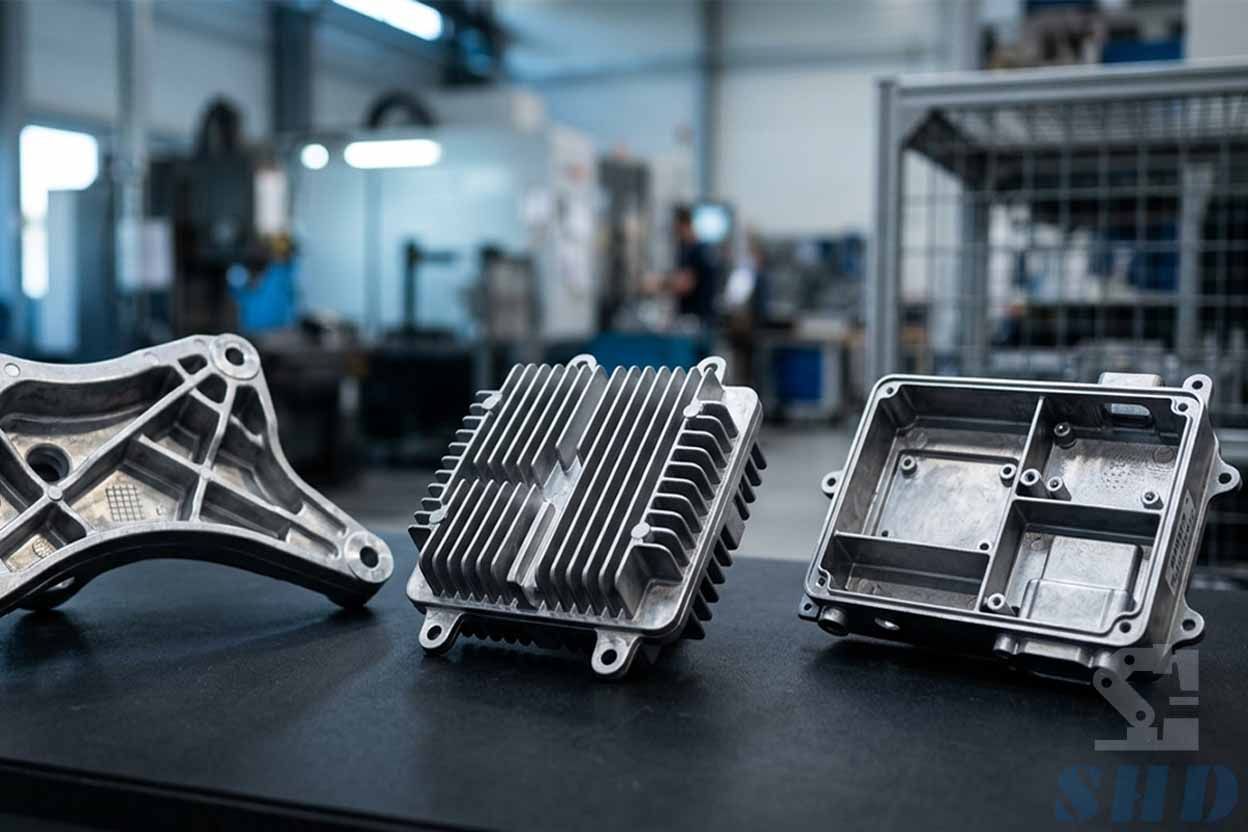
Choosing between aluminum and zinc is not a minor detail—it changes the machine configuration, the tooling design, and the economics of the entire project. Aluminum alloys such as A380 and ADC12 are the workhorses of the industry, used in approximately 70% of die casting projects. They offer an excellent strength-to-weight ratio and good corrosion resistance, making them the default choice for automotive structural parts, LED housings, and engine brackets. Zinc alloys, on the other hand, deliver higher tensile strength (280–440 MPa versus aluminum's 220–310 MPa) and superior ductility. Zinc also reproduces fine surface details more faithfully and allows thinner wall sections. A 2023 field study on automotive sensor housings found zinc achieved a 92% first-pass yield, outperforming aluminum's 84% due to lower porosity rates. The tradeoff is weight—zinc is roughly 2.5 times denser than aluminum.
Porosity Defects: The Number One Enemy in High Pressure Die Casting
Porosity remains the single most significant problem in high pressure die casting. Tiny voids or air pockets form inside the casting material, usually because gas gets trapped during the injection phase. Turbulent metal flow, inadequate venting, and rapid cooling all contribute. These voids weaken structural integrity, compromise pressure tightness, and ruin surface finishes.
The causes are well understood. When molten metal rushes into the die too fast, it creates turbulence that traps air. When die temperatures run too high or pressure-holding time falls short, gas expands beneath the surface and forms blisters. When wall thickness varies abruptly, uneven cooling creates shrinkage voids in the thicker sections. Each defect type points back to a specific process variable that can be measured, controlled, and optimized.
Cold Shuts and Flash: Flow Problems That Kill Production Efficiency
Cold shuts appear as visible lines where separate metal flows meet but fail to fuse completely. This happens when the metal is too cool or injection speed is insufficient. The result is a weak seam that can crack under stress. Flash occurs when excess metal escapes between the die halves, creating a thin unwanted layer on the part edges. Excessive injection pressure, misaligned dies, or worn sealing surfaces are the usual culprits. Neither defect is catastrophic individually, but together they account for roughly 60–65% of all quality problems on production lines. Manufacturers that adjust melt temperatures, redesign gates for smoother flow, and optimize injection speeds report cutting rejection rates by over 40%.
What a Proper Quality Control System Looks Like
A serious high pressure die casting operation does not rely on visual inspection alone. Automated coordinate measuring machines validate part dimensions within 5-micron tolerances. X-ray inspection identifies subsurface flaws that no human eye could detect. Phased-array ultrasonic testing examines 100% of high-stress components, achieving defect escape rates below 0.02%. Plasma-nitrided mold surfaces maintain surface finish requirements three times longer than conventional coatings, directly impacting part consistency across production batches. Preventive mold maintenance schedules every 50,000 cycles preserve critical clearances. These protocols are not optional extras—they are the difference between a supplier that delivers and one that makes excuses.
The Purchasing Decision: What to Specify
When sourcing high pressure die casting components, include these specifications in your request:
-Alloy grade (A380, ADC12, ZAMAK, or others) with mechanical property requirements clearly stated
-Dimensional tolerances (industry standard precision tolerances are available from NADCA)
-Surface finish requirements (Ra values)
-Porosity limits and inspection methods
-Sample approval process before full production
-Quality control documentation requirements
These details separate a smooth sourcing experience from one consumed by rework, delays, and finger-pointing.
Conclusion
Reliable high pressure die casting is not about buying a machine and turning it on. It is about controlling melt temperature within tight bands, managing injection speed and pressure with precision, designing molds that fill smoothly and cool evenly, and inspecting every critical dimension with instruments that measure in microns. The difference between success and failure in high pressure die casting is measured in degrees Celsius, milliseconds, and micrometers.
Need High Pressure Die Casting Components for Your Next Project?
Work with a manufacturer that controls the entire process—alloy selection, mold design, injection parameter optimization, and 100% quality inspection—under one roof. From design review to final shipment, the right production partner turns your engineering requirements into components that meet specifications, not someone's approximation.
Not every supplier operates with the same level of process control. What sets SHD Precision Diecasting apart is the integration of the entire production chain under one roof. Tool and mold fabrication happens in-house. CNC secondary machining—using five-axis and three-axis machining centers, lathes, and drilling equipment—refines cast components to final specifications. Surface finishing options include anodizing, powder coating, electroplating, and polishing. A documented ISO 9001 quality management system governs every stage, from incoming material inspection to pre-shipment verification. The company serves automotive, aerospace, medical devices, consumer electronics, and industrial equipment sectors.