
Gravity Die Casting vs Pressure Die Casting: Which Process Fits Your Part?


Gravity die casting vs pressure die casting is primarily a choice between controlled gravity filling and high-speed, high-pressure injection. Pressure die casting is usually better suited to high-volume production, thin walls, complex geometry, and short cycle times. Gravity die casting is often considered for thicker components, lower tooling investment, internal features formed with cores, and projects where controlled mold filling or subsequent heat treatment is important.
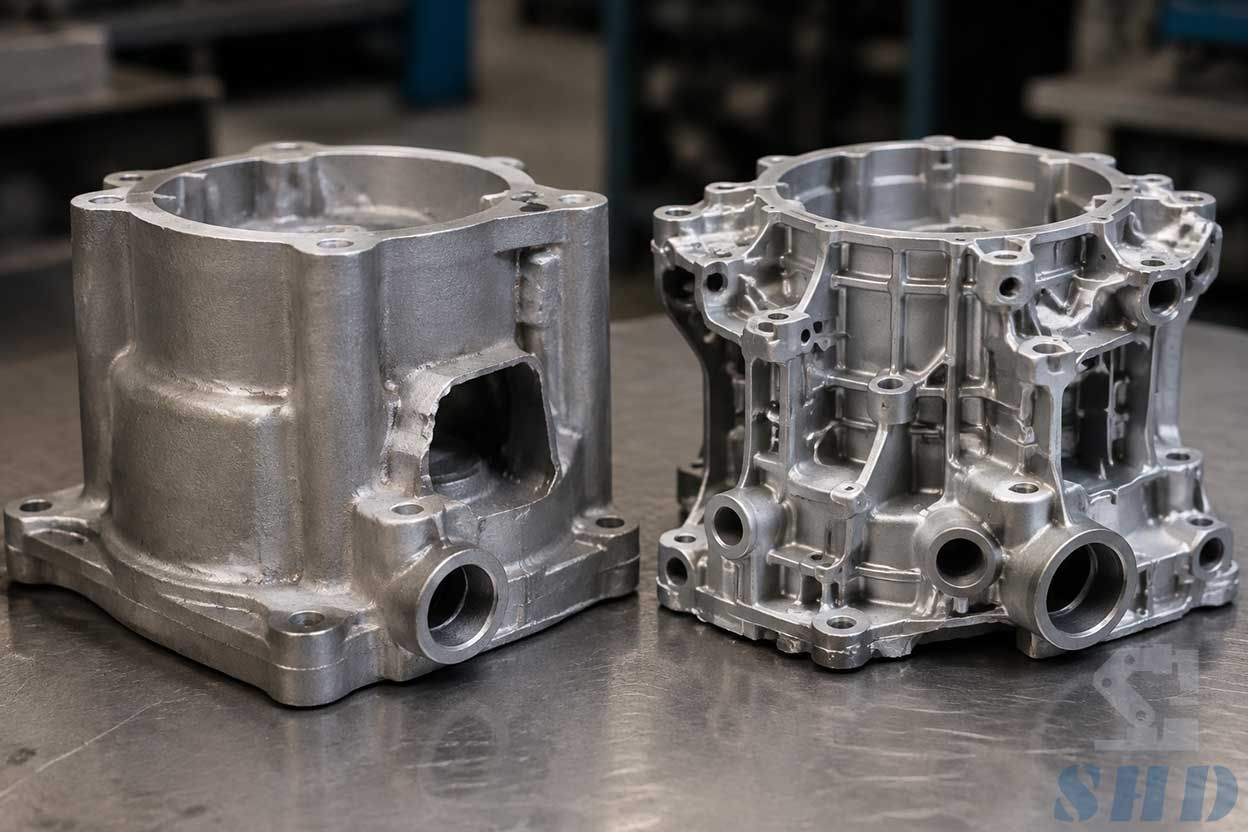
Neither process is automatically better. The correct choice depends on the drawing, alloy, annual quantity, wall thickness, mechanical requirements, machining plan, pressure-tightness expectations, and acceptable tooling investment.
Gravity Die Casting vs Pressure Die Casting: The Direct Answer
Gravity die casting, also known as permanent mold casting, fills a reusable metal mold through the natural force of gravity. Pressure die casting forces molten metal into a reusable steel die under high pressure. NADCA defines conventional die casting as a process in which liquid metal is injected into a reusable steel die at high pressure, while permanent mold casting uses a metal mold without the same high-speed injection mechanism.
The slower filling behavior of gravity die casting can reduce the risk of air entrapment when the gating system and pouring conditions are properly controlled. However, gravity filling does not guarantee a defect-free casting. Poor feeding, abrupt wall thickness changes, unsuitable mold temperature, or unbalanced solidification can still cause shrinkage porosity, oxide inclusions, cold shuts, or incomplete filling.
Pressure die casting provides greater filling force and production speed. It can reproduce thin sections, ribs, bosses, lettering, and detailed surfaces that may be difficult to fill consistently by gravity alone. The tradeoff is that high-speed metal flow can trap air, making venting, overflow design, injection control, and vacuum assistance important for applications sensitive to porosity. Research on aluminum high pressure die casting identifies air entrapment during rapid mold filling as a major source of internal porosity.
How the Two Processes Fill the Mold
In gravity die casting, molten metal enters the metal mold through a pouring basin, runner, and gate. The mold must be positioned and designed so that metal can reach all critical areas before premature solidification occurs.
Because gravity provides the filling force, flow distance, section thickness, alloy fluidity, pouring temperature, mold coating, and die temperature all affect whether the cavity fills successfully. Thin isolated sections and sudden changes from thick to thin walls may be difficult to produce without modifying the part or gating design.
In pressure die casting, molten metal is delivered into the die cavity by a plunger or injection system. High filling speed allows the metal to reach narrow sections before solidification. This is one reason high pressure die casting is widely used for complex, near-net-shape components with relatively thin walls and repeatable surface features.
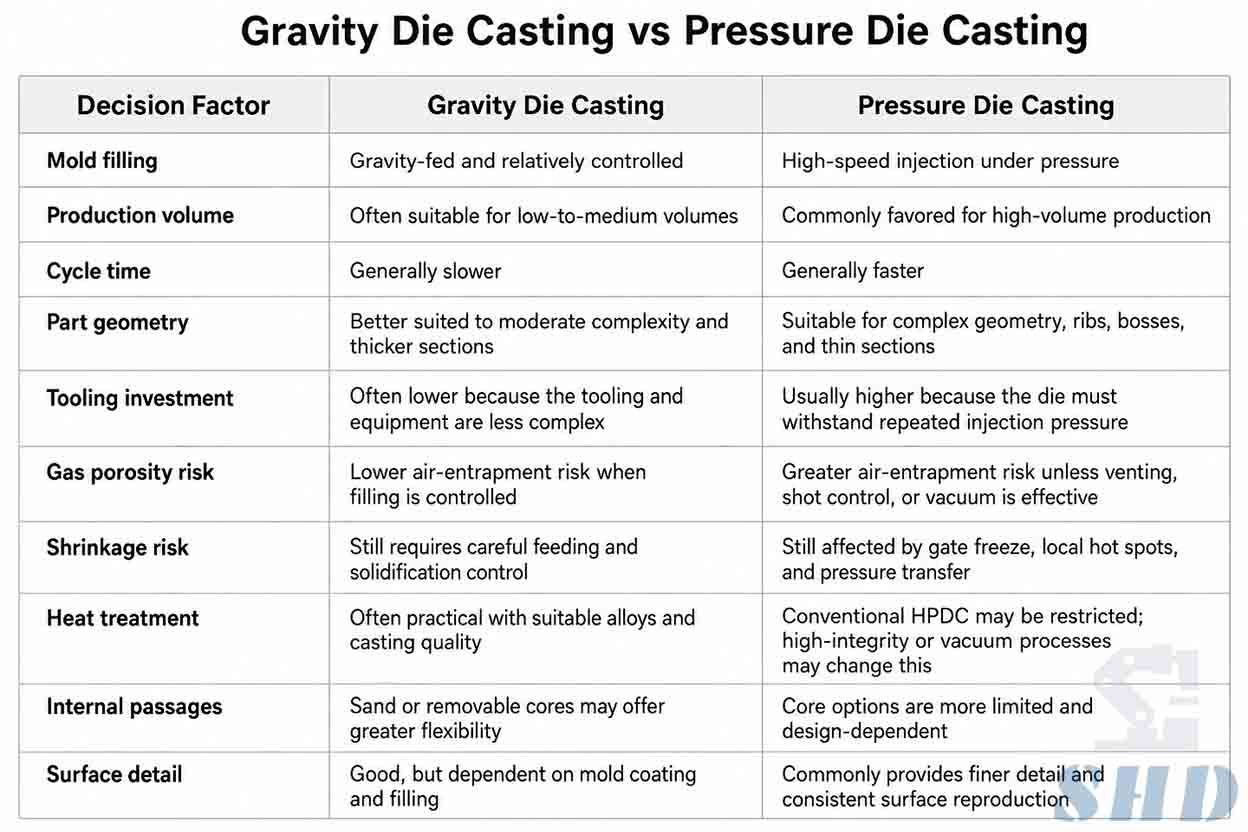
These are typical process tendencies rather than guaranteed results. A poorly designed gravity casting may contain more defects than a well-controlled pressure die casting. Process capability must therefore be evaluated together with the part design and quality plan.
Production Quantity and Tooling Economics
Pressure die casting normally requires a larger initial tooling investment. The die may include slides, ejector systems, cooling circuits, overflows, vents, and replaceable inserts. It must also tolerate repeated thermal cycling and injection forces.
This investment becomes more economical when the required quantity is high enough to spread tooling costs across many parts. Short cycle times and automated part removal can further reduce the production cost per unit.
Gravity die casting tooling is often simpler and less expensive, making permanent mold casting attractive when projected quantities do not justify a complex pressure die. However, buyers should compare total project cost rather than tooling price alone.
A lower mold price may be offset by slower production, additional finishing, greater machining allowance, or more manual handling. Conversely, an expensive pressure die may not be economical when the order quantity is limited or the design is expected to change.
Porosity, Strength, and Heat Treatment
It is common to describe gravity die casting as the low-porosity option, but the more accurate conclusion is conditional. Slower filling can reduce turbulent air entrapment, yet shrinkage porosity may still develop if thick sections are not properly fed or if cooling is unbalanced.
Important gravity casting variables include runner and riser design, pouring consistency, mold coating thickness, die temperature, local section thickness, and solidification direction. Research on permanent mold casting shows that heat transfer and casting thickness directly influence shrinkage porosity, dimensional stability, microstructure, and cycle time.
In pressure die casting, porosity can originate from trapped air, solidification shrinkage, lubricant-related gas, or poor pressure transfer after the cavity is filled. Gate position, vent area, overflow placement, slow-shot and fast-shot transitions, intensification pressure, die temperature, and cooling balance all influence the result.
Conventional high pressure die castings may have limitations when high-temperature heat treatment is required because trapped gas can expand and create surface blistering. This should not be treated as a universal rule. Vacuum-assisted and other high-integrity pressure die-casting processes can reduce gas content and may support different heat-treatment strategies, depending on the alloy and validated production process. NADCA treats conventional HPDC and high-integrity casting processes as distinct technical categories.
Geometry and Wall Thickness Matter More Than Labels
The process should not be selected only because a component is described as strong, durable, complex, or high volume. The actual geometry must be reviewed.
Pressure die casting is often preferred when the drawing contains thin walls, narrow ribs, small bosses, integrated mounting features, or detailed cosmetic surfaces. High injection pressure improves cavity filling, but it does not remove the need for consistent wall transitions and suitable draft angles.
Large variations in wall thickness can create local hot spots, uneven solidification, distortion, sink marks, or machining exposure to internal porosity. Thick sections should not be added simply to increase strength without reviewing load paths and solidification behavior.
Gravity die casting may offer more flexibility for parts that require sand cores, hollow regions, or internal channels. However, core positioning, dimensional variation, cleaning access, and additional finishing must be included in the manufacturing plan.
Questions Buyers Should Answer Before Selecting a Process
A useful casting inquiry should provide more than a three-dimensional model. Buyers should clarify:
1. Expected order quantity and annual demand
2. Prototype, bridge-production, or long-term production needs
3. Preferred alloy or required material properties
4. Minimum and maximum wall thickness
5. Critical dimensions and datum surfaces
6. Machined holes, sealing faces, and threaded areas
7. Pressure-tightness or leakage requirements
8. Heat-treatment, welding, coating, or plating requirements
9. Cosmetic surface expectations
10. Acceptable tooling budget and development schedule
These details help determine whether the project needs the speed of pressure die casting, the filling characteristics of gravity die casting, or another manufacturing method.
A Common Sourcing Mistake
One common mistake is selecting gravity die casting only because its tooling appears cheaper. Another is choosing pressure die casting only because the part quantity is high.
Tooling cost and order quantity are important, but they should not override functional requirements. A high-volume part may still be unsuitable for conventional pressure die casting if its internal integrity, heat-treatment route, or core structure cannot be achieved reliably. A lower-volume part may still justify pressure die casting when its geometry cannot be filled economically through gravity casting.
The decision should balance tooling investment, unit cost, quality risk, secondary machining, scrap exposure, and the possibility of future design changes.
Conclusion
Gravity die casting vs pressure die casting is not simply a comparison between quality and speed. Gravity die casting offers controlled filling, core flexibility, and typically lower tooling investment, but it remains sensitive to feeding and solidification control. Pressure die casting provides faster cycles, thin-wall capability, detailed geometry, and strong repeatability, but its high-speed filling requires careful management of trapped air and porosity.
The most suitable process is the one that satisfies the part's functional requirements at a sustainable total cost. Buyers should evaluate geometry, quantity, alloy, machining, pressure tightness, heat treatment, and tooling strategy before committing to either method.
The most suitable process is the one that satisfies the part's functional requirements at a sustainable total cost. Buyers should evaluate geometry, quantity, alloy, machining, pressure tightness, heat treatment, and tooling strategy before committing to either method.
Discussing Your Casting Project with SHD Precision Diecasting
SHD Precision Diecasting supports custom die-casting project discussions based on part drawings, production quantities, functional surfaces, and downstream processing requirements.
Rather than selecting a process from a general comparison alone, buyers can provide their drawings and key quality expectations for a more focused manufacturability review. This helps identify whether pressure die casting is suitable and which design, tooling, or quality-control questions should be resolved before production planning begins.