
One-Piece or Multi-Part Die Cast Housing Design? A Tooling and Assembly Checklist


An effective die cast housing design must balance structural requirements with tooling feasibility, machining accessibility, and assembly costs. Integrating multiple features into one casting can reduce component count but may complicate mold construction. Dividing the same housing into separate components can simplify individual castings while introducing additional assembly interfaces. For engineers and purchasing teams, evaluating one piece vs multi part housing options before tooling begins helps identify manufacturing risks and avoid costly structural revisions.
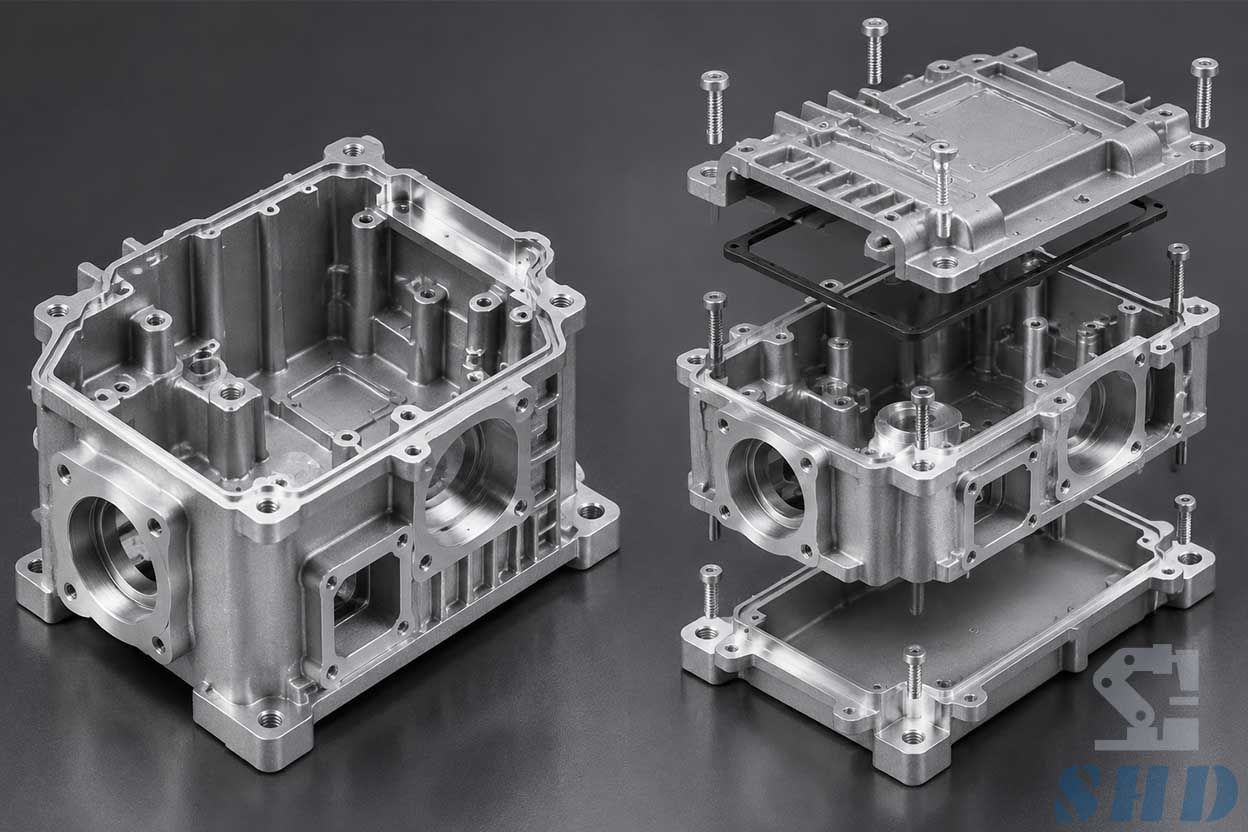
Die Cast Housing Design: Integrated or Multi-Part Structures?
Consider an industrial equipment housing with internal mounting bosses, lateral openings, and a protective cover. Two manufacturing configurations are possible:
l One-piece housing: The main enclosure and selected structural features are integrated into a single casting.
l Multi-part housing: The same enclosure is divided into separate cast sections that are subsequently connected.
l Both configurations must satisfy equivalent functional requirements. Their differences primarily concern mold construction, secondary machining, dimensional control, assembly, and maintenance.
Comparing Tooling Complexity and Machining Accessibility
An integrated housing may require deep cores, multiple draft directions, or retractable slides to form transverse openings and internal undercuts. These mechanisms can increase mold fabrication costs, maintenance requirements, and production lead times.
Dividing the housing may simplify mold release and reduce the need for certain side actions. However, separate components may require additional molds, trimming tools, and machining fixtures.
Machining accessibility is equally important. Internal bearing seats, threaded holes, and mounting surfaces can be difficult to reach inside an integrated enclosure. Separate castings may provide more direct tool access but require additional machining setups.
A practical die cast housing design should therefore evaluate tooling and machining together rather than treating them as independent manufacturing stages. During die casting mold processing, core movement, cavity geometry, and release requirements must reflect the approved housing configuration.
Housing Assembly Tolerances and Dimensional Control
Individual components meeting their drawing tolerances do not necessarily guarantee an acceptable assembled housing. In multi-part structures, dimensional variation can accumulate across locating features, machined interfaces, fastener holes, and mating surfaces. These relationships may affect bearing alignment, internal clearance, and sealing performance.
Engineers should define housing assembly tolerances using functional datums and a documented tolerance stack. Locating pins, machined reference surfaces, and controlled joint geometry can help establish repeatable assembly positioning.
Integrated housings eliminate some inter-component tolerance relationships, although machining accuracy and casting distortion still require careful control.
Bolted Connections, Welded Joints, and Sealing
Bolted and welded connections introduce different manufacturing requirements. Bolted connections support disassembly, component replacement, and maintenance. Their design must accommodate fastening access, thread engagement, locating features, and controlled clamping forces.
Welded connections create permanent joints but require alloy-specific weldability assessment. Gas porosity in conventional high-pressure die castings can complicate welding, while thermal distortion may affect dimensional accuracy. Welding feasibility must therefore be validated for the specific material, casting process, and joint configuration.
Sealing requirements also influence the comparison. Integrated structures can eliminate certain joint interfaces, while multi-part housings may require gaskets, controlled sealing-face flatness, and uniform compression.
One Piece vs Multi Part Housing: Comparing Total Manufacturing Costs
A meaningful cost comparison extends beyond the unit casting price.
| Cost Factor | One-Piece Housing | Multi-Part Housing |
| Tooling | Potentially complex cores and slides | Potentially more individual molds |
| Machining | Restricted access to internal features | Additional setups and interfaces |
| Assembly | Fewer joining operations | Additional joining and locating operations |
| Sealing | Fewer potential joint interfaces | Additional sealing requirements |
| Maintenance | Potentially limited internal access | Greater disassembly flexibility |
Neither configuration guarantees lower costs. Production volume, tooling maintenance, machining time, assembly labor, inspection requirements, and expected rejection rates must all be considered.
When Should Housing Dimensions Be Inspected?
The inspection plan should distinguish three manufacturing stages:
- After casting: Verify overall geometry, machining allowances, and relevant casting defects.
- After machining: Measure critical bores, mounting holes, datum surfaces, and sealing faces.
- After assembly: Confirm functional alignment, clearances, joint positioning, and specified sealing performance.
Defining these acceptance stages early ensures that housing assembly tolerances are evaluated in the correct manufacturing condition.
A Pre-Tooling Checklist for Housing Development
Before approving a die cast housing design, engineering and purchasing teams should confirm:
- Primary draw direction, draft angles, and side-action requirements.
- Number of molds and secondary machining fixtures.
- Machining accessibility and functional datum relationships.
- Connection methods, sealing requirements, and maintenance access.
- Inspection stages and final assembly acceptance criteria.
- Total manufacturing cost at the expected production volume.
At SHD Precision Die Casting, we support housing projects through quotation evaluation, DFM review, mold development, sampling, and secondary machining.
By reviewing structural alternatives before tooling begins, engineering and purchasing teams can establish a manufacturing route that balances investment, production efficiency, assembly reliability, and dimensional acceptance.
Frequently Asked Questions
Q&A 01 | Is a one-piece die cast housing always more economical?
No. Although an integrated housing can reduce assembly operations, complex mold structures, side actions, and restricted machining access may increase overall manufacturing costs. Both configurations should be evaluated against the expected production volume.
Q&A 02 | When should a die cast housing be divided into multiple parts?
A multi-part configuration may be preferable when separating the structure improves mold release, machining accessibility, internal inspection, or maintenance access. Additional assembly and sealing requirements must also be considered.
Q&A 03 | How are assembly tolerances controlled in die cast housings?
Assembly tolerances can be controlled through functional datum selection, tolerance stack analysis, precision machining, locating features, and dimensional verification of the completed assembly.
Q&A 04 | Can aluminum die cast housings be joined by welding?
Welding feasibility depends on the aluminum alloy, casting process, internal porosity, and joint design. Conventional high-pressure die castings may present welding challenges, so the proposed joining process should be validated before production approval.