
Custom Die-Casting Services Turn Product Designs Into Scalable Parts


Custom die-casting services help OEM companies transform product drawings into repeatable metal components that can be produced efficiently at scale. At SHD Precision Die Casting, we treat each project as a coordinated manufacturing program rather than a single casting order because material, tooling, tolerances, machining, finishing, and assembly requirements are closely connected.
How Custom Die-Casting Services Support OEM Product Development
A successful die casting project normally begins before the mold is built. The first stage is reviewing the 3D model, technical drawing, functional requirements, and expected production quantity. During this review, our engineers evaluate wall thickness, draft angles, ribs, bosses, undercuts, parting lines, ejector locations, and potential machining areas. These details determine whether custom die-cast components can be produced with stable metal flow and reliable mold release.
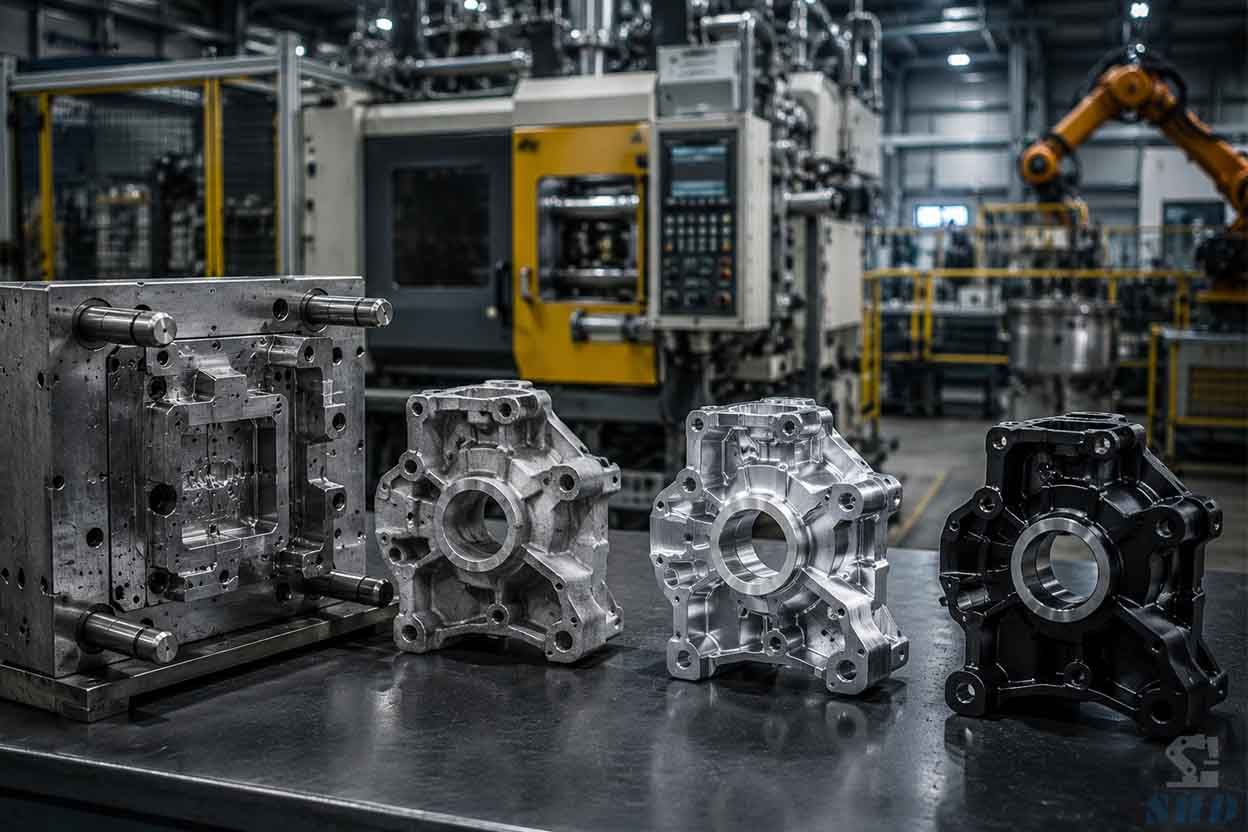
Early engineering review also helps identify unnecessary complexity. A small design adjustment may reduce tooling risk, simplify machining, or improve surface quality without changing the product's function.
Material Selection Affects More Than Part Weight
Aluminum, zinc, and magnesium alloys each offer different advantages. Aluminum is commonly selected for lightweight housings, brackets, motor parts, and industrial structures. Zinc supports fine details, thin sections, and decorative finishes. Magnesium is useful when aggressive weight reduction is a major design priority.
At SHD Precision Die Casting, material selection is based on mechanical strength, corrosion resistance, weight, thermal performance, finishing requirements, and production volume. Reliable die casting project support means helping customers choose an alloy that fits both product performance and manufacturing conditions.
Selecting material only by price can create problems later. A lower-cost alloy may not provide the required strength, appearance, or finishing compatibility.
Tooling Determines Long-Term Production Stability
The mold is one of the most important investments in custom die-casting services. Gate position, runner balance, venting, overflow design, cooling channels, and core movement all affect casting quality. If these systems are poorly planned, defects such as porosity, cold shuts, flash, distortion, or incomplete filling may appear during production.
For custom die cast components, the mold must also account for expected production volume. Prototype tooling, bridge tooling, and long-life production molds are designed differently. Choosing the correct tooling strategy helps control both initial cost and long-term output.
Secondary Operations Complete the Finished Component
Many castings require additional work after ejection and trimming. Common operations include CNC machining, drilling, tapping, polishing, shot blasting, powder coating, plating, painting, and assembly. These processes should be considered before tooling begins because machining allowances, datum surfaces, clamping points, and cosmetic zones influence mold design.
Effective die casting project support connects casting and secondary operations into one production plan. This reduces the risk of creating a casting that meets dimensional requirements but becomes difficult to machine, finish, or assemble.
What We Monitor During Actual Die Casting Production
In actual production, casting stability is rarely determined by one machine setting alone. At SHD Precision Die Casting, we monitor the relationship between die temperature, injection speed, metal temperature, spraying time, cooling balance, and casting appearance throughout the production run.
One practical issue is that a part may look stable during the first samples but begin to show variation after continuous cycling. As the die reaches a different thermal condition, flash, local shrinkage, sticking, or dimensional movement may appear. For this reason, custom die-casting services should evaluate not only the first accepted parts but also the consistency of castings produced after the process reaches a stable cycle.
Venting condition is another detail that requires regular attention. Release agent residue, metal buildup, or blocked overflow areas can reduce air discharge and increase porosity or incomplete filling. These problems may not always be visible on the raw surface. In some custom die cast components, internal defects only become apparent after CNC machining exposes small cavities.
We also pay close attention to ejection behavior. If a casting requires excessive force to leave the die, the cause may relate to insufficient draft, uneven cooling, local sticking, or an unsuitable ejector arrangement. Continuing production without correcting the cause can damage the part surface and increase die wear.
From our experience, effective die casting project support depends on recording these production changes and adjusting the process before they develop into repeated defects. Stable manufacturing comes from controlling the complete casting cycle, not from relying on a single approved sample.
Conclusion
Custom die-casting services combine engineering review, alloy selection, mold development, casting control, and secondary processing into one scalable manufacturing route. When these stages are planned together, custom die cast components can achieve more stable quality and lower long-term production risk.
Supporting Your Project From Drawing to Production
At SHD Precision Die Casting, our custom die-casting services cover manufacturability review, tooling development, sampling, machining, finishing, inspection, and batch production. Through practical die casting project support, we help OEM customers turn new designs into production-ready metal parts.