
Brake Pedal Die-Casting: Lightweight Design and Structural Performance


Brake pedal die-casting offers an alternative to traditional stamped and welded steel pedal assemblies. By using aluminum alloys, manufacturers can develop lightweight pedal structures with integrated ribs, pivot features, and mounting areas while reducing the number of separately formed components.
However, a brake pedal is a safety-critical component. Its performance depends not only on weight reduction but also on structural stiffness, fatigue resistance, casting quality, and the ability to withstand different driving loads. For automotive braking applications, the real engineering challenge is making the component lighter without compromising its intended function.
How Brake Pedal Die-Casting Balances Weight and Strength
Aluminum has a lower density than steel, making it attractive for lightweight automotive components. Die casting also allows complex structural features to be formed within a single primary component, potentially reducing the forming and welding operations associated with certain steel pedal designs.
A 2016 study by Cho and Jang, published in the Journal of the Korean Society of Manufacturing Technology Engineers, investigated die-cast aluminum brake pedals as an alternative to steel designs. The researchers reported approximately 26% lower weight and 24% lower stress for their evaluated aluminum pedal design. Their analysis also indicated that increasing a frame section from 12 mm to 18 mm was necessary to achieve the required strength. These findings illustrate an important point: lightweight design does not always mean thinner walls. Increasing material in critical areas can improve structural performance while the overall aluminum component remains lighter.
Pivot Holes and Structural Transitions Need Attention
Brake pedals experience repeated loading during normal operation. Forces may act in the intended pedaling direction or at an angle when the driver presses the pedal off-center. Pivot holes, arm roots, mounting areas, and transitions between thick and thin sections can become stress concentration points.
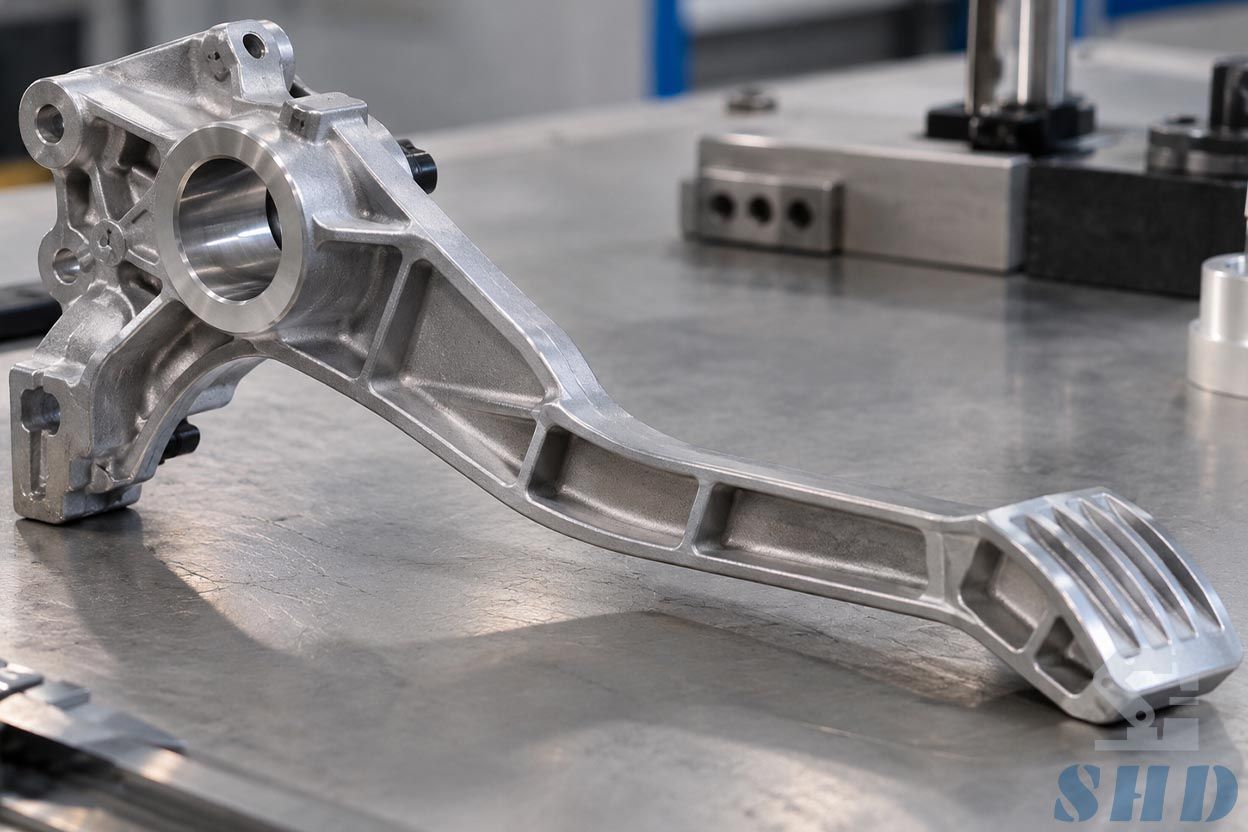
Suitable fillet radii, reinforcing ribs, and gradual wall transitions can help distribute loads more effectively. Finite element analysis is useful for identifying highly stressed areas before mold development. These considerations are particularly important when adapting a steel pedal design for aluminum die casting rather than simply reproducing the original geometry.
Casting Quality and CNC Finishing Work Together
A die-cast brake pedal must maintain appropriate internal quality around its load-bearing sections. Gate position, metal flow, venting, die temperature, and cooling influence how molten aluminum fills and solidifies inside the mold. Porosity or other casting defects near highly stressed areas may affect fatigue performance. After casting, CNC machining may be required for pivot bores, mounting holes, mating surfaces, and other precision features.
Deburring and surface finishing can also be incorporated according to the component specification. Protective coatings should be selected with the alloy and operating environment in mind.
Automotive Validation Goes Beyond Static Strength
Brake pedal reliability cannot be determined from a single load test. Depending on the vehicle program, validation may include forward pedaling loads, lateral forces, repeated fatigue cycles, stiffness measurements, and performance at specified temperature extremes. The same engineering principles also matter in new energy processing projects involving electric and hybrid vehicle components. Although their braking systems may incorporate regenerative braking, pedal structures must still satisfy the applicable vehicle-level functional and safety requirements.
Specific acceptance criteria depend on the automotive manufacturer's specifications and the relevant product validation plan.
A Recent Reminder About Brake Pedal Structural Safety
Recent automotive braking tests have brought renewed attention to brake pedal durability after support fractures were reported during repeated emergency braking. Although the manufacturer subsequently presented additional testing results, the incident raised important questions about structural design, loading conditions, and safety margins.
The reported failure involved a reinforced-polymer support rather than an aluminum die casting, so it should not be interpreted as proof that one material is inherently safer than another.
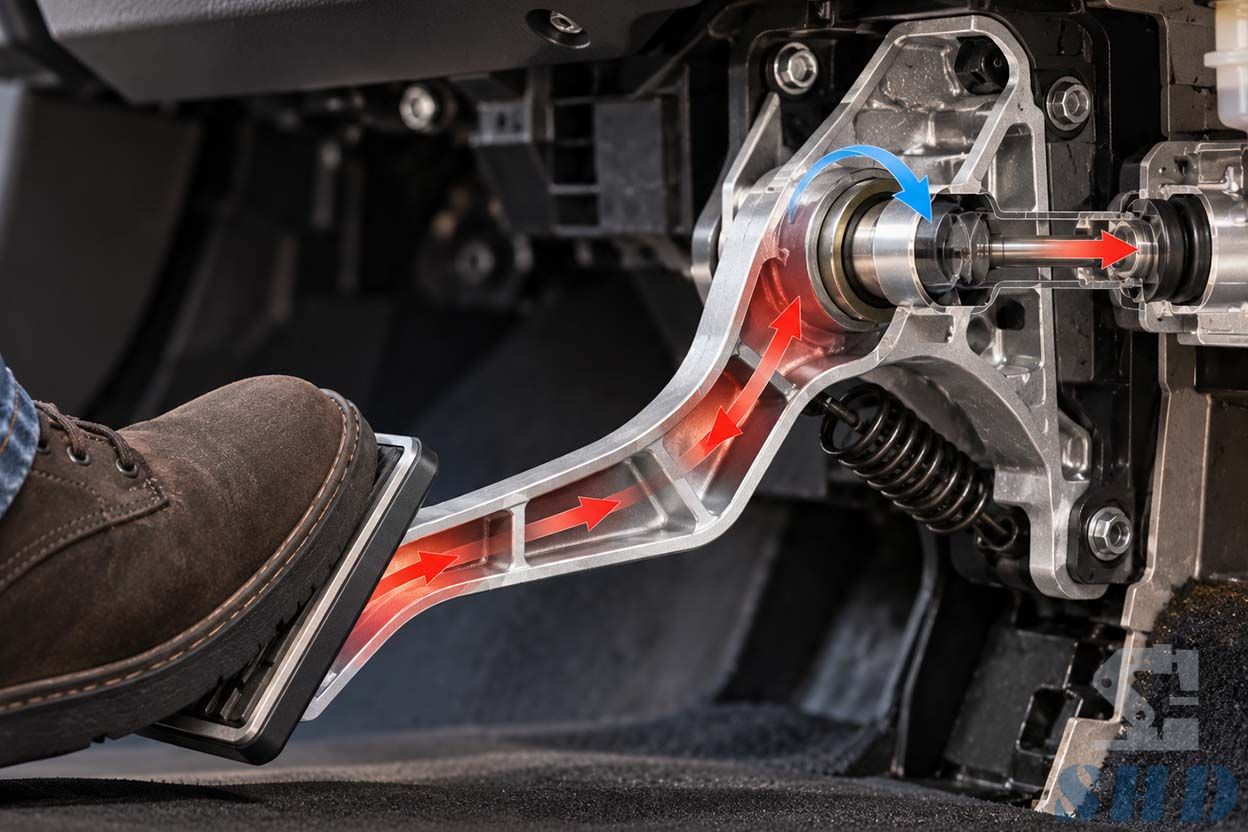
For brake pedal manufacturers, the broader lesson is that material strength alone cannot guarantee component reliability. Pivot geometry, stress concentrations, off-axis loading, manufacturing consistency, and validation under realistic operating conditions must all be considered before a design enters production.
⭐Supplementary Information⭐ Latest Advisory Regarding the Structural Safety of Brake Pedals
Recent automotive braking tests have brought renewed attention to brake pedal durability after support fractures were reported during repeated emergency braking. Although the manufacturer subsequently presented additional testing results, the incident raised important questions about structural design, loading conditions, and safety margins.
The reported failure involved a reinforced-polymer support rather than an aluminum die casting, so it should not be interpreted as proof that one material is inherently safer than another. For brake pedal manufacturers, the broader lesson is that material strength alone cannot guarantee component reliability. Pivot geometry, stress concentrations, off-axis loading, manufacturing consistency, and validation under realistic operating conditions must all be considered before a design enters production.
Conclusion
Brake pedal die-casting demonstrates how aluminum alloys and integrated casting designs can contribute to automotive lightweighting. Its success depends on structural optimization, controlled metal forming, machining accuracy, and appropriate safety validation rather than material weight alone.
For manufacturers, the most effective development route begins with identifying critical loads, pivot locations, wall thickness transitions, and inspection requirements before tooling begins.
Automotive Die Casting Solutions from SHD Precision Die Casting
SHD Precision Die Casting supports custom metal component development through technical discussions covering part geometry, material selection, tooling considerations, machining requirements, and production planning. For automotive pedal-related components, reviewing structural features, casting risks, critical dimensions, and downstream processing early can help establish a more practical manufacturing strategy.
Frequently Asked Questions
Q&A-01. Can aluminum die-cast brake pedals replace steel pedals in every vehicle?
Not automatically. Each design requires evaluation of its geometry, material properties, loads, fatigue requirements, and vehicle-specific specifications. A successful design for one vehicle does not establish suitability for another.
Q&A-02. What documentation should automotive buyers provide?
Useful information includes a 3D model, technical drawing, material specification, critical tolerances, expected production volume, load cases, and required validation procedures.
Q&A-03. Does anodizing improve the structural strength of an aluminum brake pedal?
Anodizing primarily modifies surface properties. It should not be considered a substitute for adequate structural design, suitable alloy properties, or validated fatigue performance. Its compatibility with the selected casting alloy must also be evaluated.