
Aluminum Die Casting Housings: Define Leak Requirements Before Tooling


Aluminum die casting housings are commonly used for industrial equipment, pumps, fluid systems, and cooling-related components. These parts may contain internal passages, mounting features, threaded ports, and machined sealing surfaces. However, a casting that looks acceptable externally is not automatically pressure-tight. Internal porosity can become exposed during CNC machining, while sealing interfaces and assembly conditions may introduce additional leakage paths.
For OEM buyers, leakage requirements should therefore be discussed before mold development rather than introduced only during final inspection.
Why Aluminum Die Casting Housings Need Clear Leak-Test Specifications
Pressure tight aluminum die casting requires coordination between part design, mold filling, solidification, machining, and final inspection.
Wall thickness transitions, isolated heavy sections, gate positions, venting, and cooling conditions can influence internal casting quality. These factors become particularly important when the component must contain pressurized air, coolant, oil, or another fluid. The first step is to identify which areas must remain sealed and under what operating conditions.
CNC Machining Can Expose Hidden Porosity
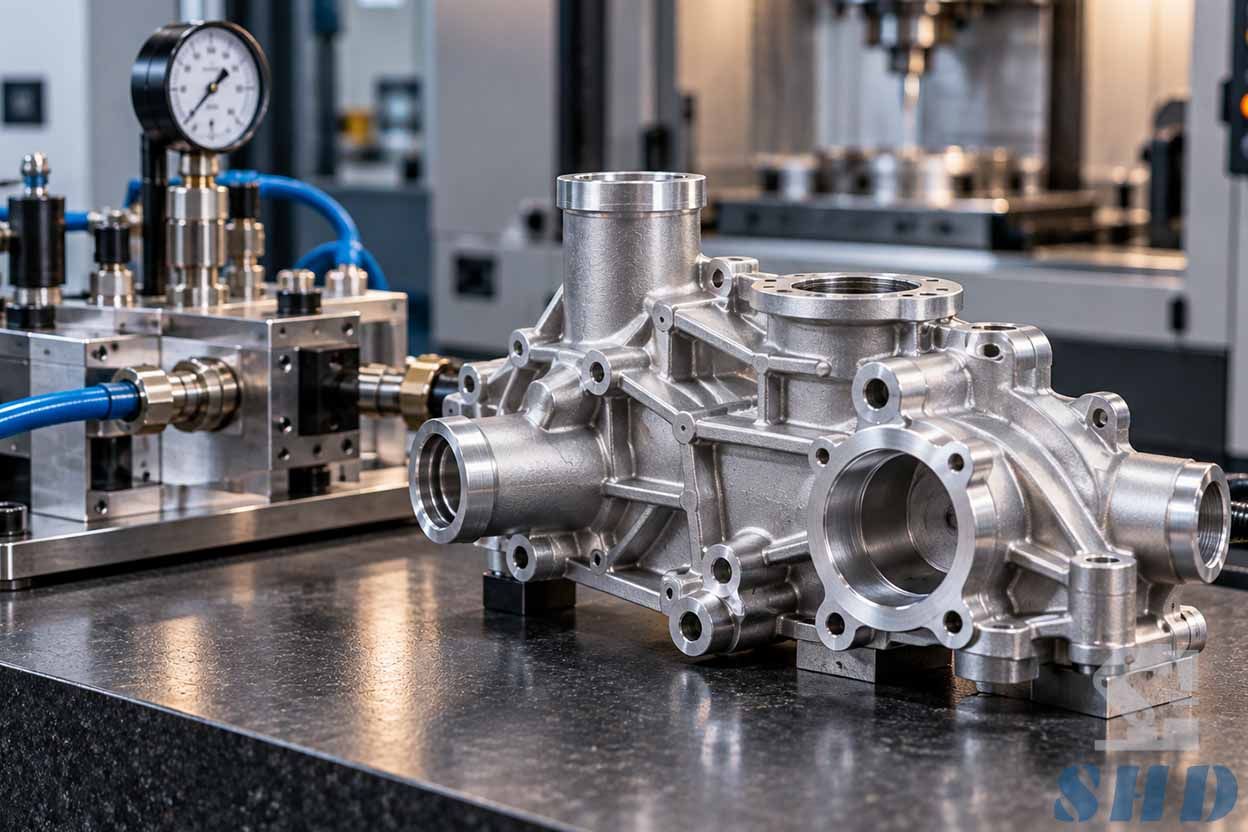
Die-cast components often require CNC machining for sealing faces, precision bores, threaded connections, and mounting surfaces. Although machining improves dimensional accuracy, removing material may expose subsurface pores. A casting that passes an initial inspection could therefore develop a leakage path after machining. This explains why leak testing after machining die cast parts is often important for pressure-containing components.
Machining allowances and critical sealing areas should be reviewed before tooling begins to reduce the risk of exposing porosity in functional regions.
Different Leak Tests Answer Different Questions
Several methods may be considered depending on the component's requirements. Bubble testing can help locate relatively large leakage paths. Pressure-decay testing measures pressure changes over a defined period, while mass-flow testing can quantify leakage under controlled conditions.
For applications requiring greater sensitivity, helium tracer-gas testing may be considered.
The appropriate method depends on the test volume, allowable leakage, operating conditions, and required detection sensitivity. A statement such as "no leakage allowed" is not a complete test specification without defined test conditions and an acceptance limit.
A statement such as "no leakage allowed" is not a complete test specification without defined test conditions and an acceptance limit.
What Should Buyers Include in an RFQ?
A practical die casting leak test specification should identify the test conditions before the manufacturer prepares tooling and inspection quotations.
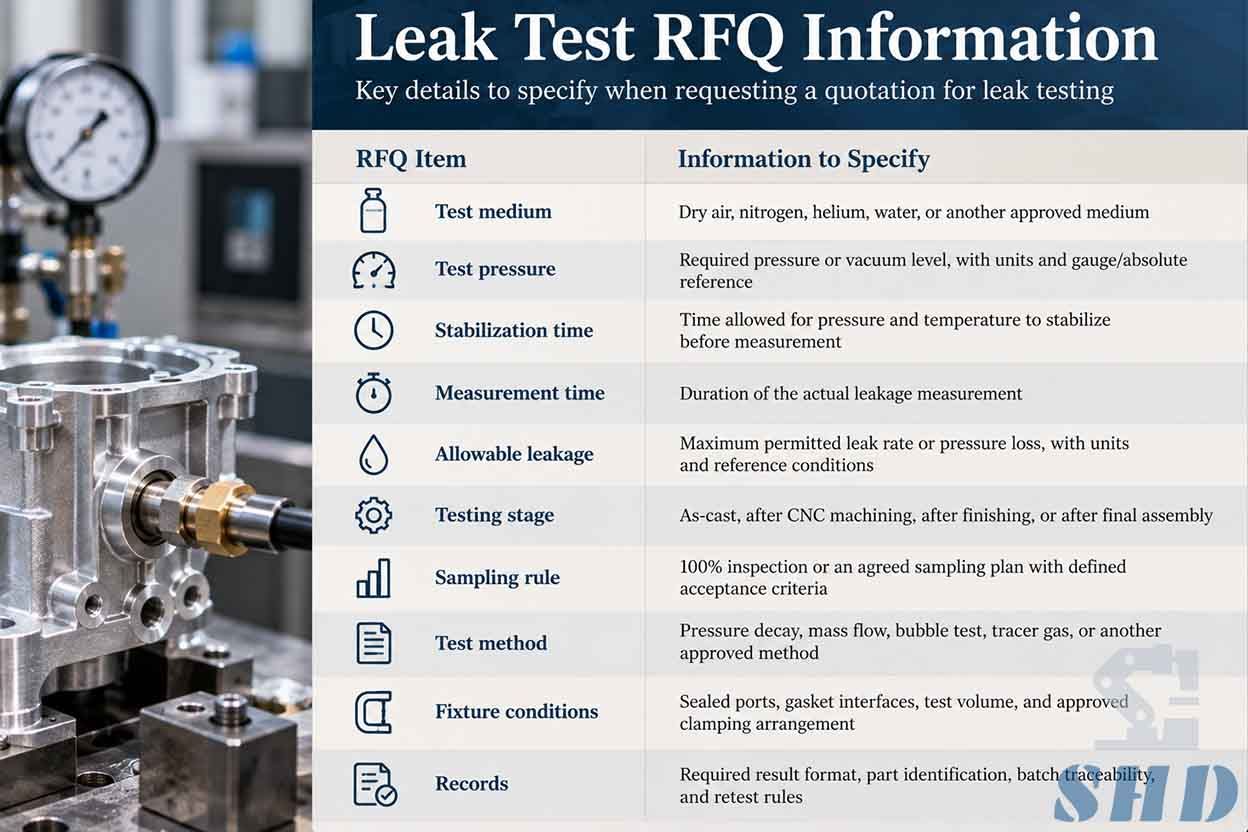
All numerical values should be agreed according to the product application. There is no universal leakage limit suitable for every aluminum housing.
Testing Conditions Affect Repeatability
Leakage measurements can be influenced by temperature, internal test volume, fixture sealing, and stabilization time. For example, pressure-decay testing may produce inconsistent results if the component temperature changes during measurement.
The buyer and supplier should therefore agree on the testing method, fixture arrangement, acceptance criteria, and any required retest procedure. This helps prevent disagreements when the same component is tested at different facilities.
Conclusion
Aluminum die casting housings require more than accurate external dimensions when pressure tightness is part of the application. Casting quality, machining allowances, sealing surfaces, and leakage testing must be considered together.
Defining the requirements before tooling helps manufacturers select appropriate production and inspection methods while giving buyers clearer acceptance criteria for finished components.
Die Casting Project Planning with SHD Precision Die Casting
SHD Precision Die Casting supports custom metal component projects based on customer drawings, material specifications, functional surfaces, and downstream machining requirements. For industrial housings, early discussion of sealing areas, potential porosity risks, machining allowances, and inspection expectations can help establish a practical manufacturing route.
Clear technical requirements also make quotations easier to compare and reduce uncertainty during production approval.